Posts

Updates: Brewing Fundamentals and Nuruk

The translation section has been updated to include a new section about brewing fundamentals and nuruk! Please check it out at the link below: Making, Drinking, and Enjoying Makgeolli | Understanding Makgeolli 2 | Brewing Fundamentals, Nuruk, Making Nuruk, etc. Also, check out part 1 of the Understanding Makgeolli section if you haven't already.  I'm not satisfied with the way blogger is handling my copypasta from MS Word, because it takes so much time to reformat everything. At least the footnotes copy over fairly well...anyway, enjoy the fresh translation!
Gravity Wins

Yesterday I took a spill on a wet staircase and ended up breaking my sacrum. Unfortunately I'll be unable to make any new brews for a while. On the bright side the recovery time should give me more opportunities to translate/study Korean. In other news I've been working on a ratio for diluting the concentrated blends of makgeolli that I make into something more palatable. So far, the blueberry makgeolli was delicious when diluted and left a mild blueberry aftertaste. I'll post more details in the near future. Stay warm and grounded, friends. B

Blueberry Makgeolli [블루베리 막걸리]

Image
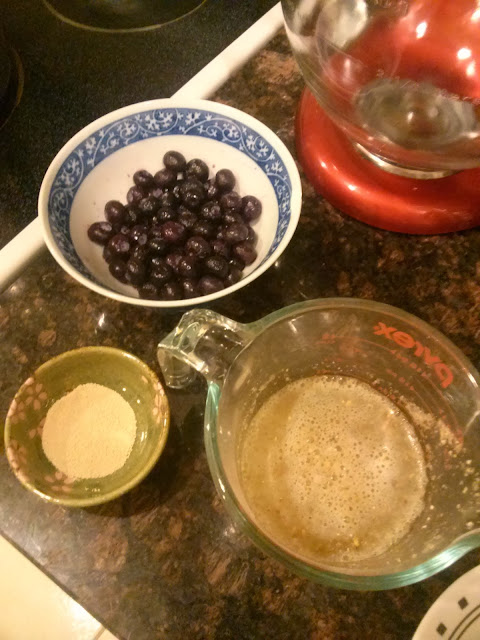
This was my first attempt at adding fruit into the brewing process. I added 150 g of blueberries to a brew with the following ratio:  500 g rice  1 liter water 50 g nuruk  3 g yeast The goal of this test batch was first and foremost to prove that it could be done. 150 g of frozen blueberries were washed and thawed to room temperature. Then, the berries were added to the brew at the same time as the yeast and hydrated nuruk (sugok). The mixture was mixed by hand for about 30 minutes before being covered and placed in a dark cabinet at 75 degrees F. The pictures are in chronological order.   This batch yielded about 48 ounces of concentrated blueberry makgeolli. Upon tasting it was obvious that this was makgeolli, but the blueberry was not so obvious. Aside from the light pink hue and a gentle aroma, there wasn't a strong indication that this was brewed with blueberries. I'll let it age for a few days in the...

Coming Soon...

Image
  ...stay tuned.

A Tasting Brew for Koreatown, USA

Image
Last week I was contacted by Matt Rodbard of Food Republic about makgeolli and makgeolli making. He is setting up to put together a book along with Deuki Hong about how Korean food has adapted/changed/evolved in the USA. You can check out a brief blurb about the book, Koreatown, USA on eater.com here . Needless to say, I am excited for the chance to discuss making makgeolli, something I enjoy doing on a regular basis. I offered to give them a taste of what I make. What else is there to do except brew? For this batch I used the ratio found in Making, Drinking, Enjoying Makgeolli but halved the portions.  Measured rice, nuruk, and yeast. Soaking rice, nuruk, and yeast. Cooling the cooked rice. This time I used a damp cheesecloth to assist in moving the rice to the fermentation jar after cooling.  The cooled rice, soaked nuruk, and yeast come together for fermentation...  ...and are stored in the dark. @ the 24 hour mark you can...

Updates: The Etymology of "Sool" (술)

The Making, Drinking, and Enjoying Makgeolli | Part 1: Understanding Makgeolli | page has been updated with a new section!  Today's update includes the etymology of the Korean word for alcohol, 술.  I started to include footnotes to add clarity to some esoteric concepts or topics. Thankfully, they carried over with the copypasta from MS Word. Unfortunately, they did not paste as functioning hyperlinks. For the time being I'll just leave them as text. I may convert them to working hyperlinks in the future if (I should say when) the document becomes terribly long.  I hope you enjoy the new content ^ ^.  The next few sections will follow the Table of Contents , picking up from the most easily learned brewing fundamentals in the world.  

Brewing with "만들고, 마시고, 즐기고, 막걸리" Ratio

Image
I started a batch of makgeolli last week with the following ratio: The ratio was taken from the book I'm currently studying, 만들고, 마시고, 즐기고, 막걸리. This will be the first brew with yeast since I stopped using during my year in Korea, and the first brew since returning to the USA. The rice and nuruk are soaking. The soak is finished, and the rice is in the pressure cooker. The rice made it out of the pressure cooker, but the indicator never rose, which led to a burnt layer of rice at the bottom of the pot. The whole kitchen smells like nurungji 누룽지 (burnt/crisp rice)now. Maybe it'll turn out to be a nurungji makgeolli. The soaked nuruk (sugok) is mixed with the yeast, which is then mixed with the cooled rice and water and placed inside the jar for fermentation. The yeast used was Red Star baking yeast. Day 1 of fermentation. The rice "cake" has formed at the top of the liquid, and the temperature appears to be around 24 C (75 F). Conditions...
