Posts

Showing posts with the label home brew

Hibiscus Makgeolli

Image
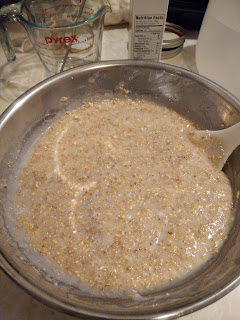
Hibiscus Makgeolli Results We started this brew on January 21st and bottled on February 13th. Below is a progression of the fermentation, followed by bottling and tasting notes. For details on the process, see our previous post  Brew Preview: Hibiscus Makgeolli . Primary fermentation begins on 1/21. Room temperature is low, around 65 F. Our first photo is 9 days later on 1/30. Small voids are visible on the surface where CO2 bubbles floated to the top and popped. Notice the rice grains are still largely intact. The next snapshot is on 2/3. The rice grains are looking more soggy, but bubbles are still popping to the surface regularly. The whole brew looks thick due to the low water content of the brew. There isn't much difference on 2/7, but the edges of the rice grains are starting to blur.  Our final snapshot before bottling on 2/13. There is a slight glimmer to the top layer from the alcohol floating to the top of the brew. Bubbling has come ...

Brew Preview: Omija Makgeolli 오미자 막걸리

Image
Currently brewing is a candidate from the brew schedule. Omija makgeolli! Omija ( Schisandra chinensis) is a small red berry that is commonly used in Korean cuisine to make omijacha, or simply omija tea. Omija directly translates to "five-flavor-berry". 

Makgeolli Brewing Certificate Program

Great things are happening in the world of makgeolli! I am excited to announce the launch of a makgeolli brewing certificate program, taught by the great people of the Susubori Brewing Academy in Korea.   Susubori has teamed up with Makgeolli Mamas and Papas Korea (MMPK) and Makgeolli Makers to provide inspired and detailed instruction for English speakers. Susubori has been leading the way in traditional Korean brewing classes taught in English for the past three years, and they've just announced their next round of courses. Now the course material has been formalized into a curriculum that ranges from your first single-stage brew to advanced infusion techniques and even distilling to make soju! The entire course is separated into two modules: Makgeolli Brewing Foundations, and Practical Applications & Analysis. If you are in Korea or are planning to visit and would like to attend one of the classes at Susubori Academy, check the link below for registration, dates, a...

Nuruk Comparison

Image
Currently brewing is a comparison between two brands of nuruk: a "market" nuruk purchased stateside and an artisan nuruk produced in Busan. Initial notes on the nuruk itself: To review, nuruk is the fermentation starter used for makgeolli and other kinds of traditional Korean beverages. It consists of fermented grains or rice and is home to a diverse set of micro-organisms. The "market" nuruk was purchased at H-Mart in the US under the brand Haeoreum. It has a pungent earthy aroma that is somewhat tangy on the nose. I would definitely describe the smell as moldy, but not foul or rank. It does not smell like decomposition. You may even describe the smell as reminiscent of a cellar or attic, but remember: no two smell alike. It definitely has an older scent than the Busan nuruk. The Busan nuruk was acquired from a friend, and I don't think it is available to purchase in the US. The aroma is a combination of earthy and woody, but neutral. There is n...

Dual Brew: Added Yeast | 100% Nuruk

Image
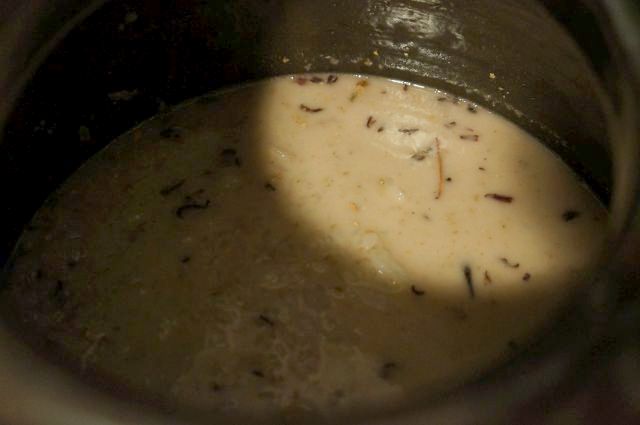
I haven't posted in a while, but a lot of good things have been happening. I've been doing a lot of travel for work, and talking to some wonderful people from the makgeolli brewing community in Korea. As part of those discussions the following two brews came about: An Iyangju using added yeast, and a Danyangju using nuruk only. Both brews used 100% sweet rice and a sweet rice starter. I'll explain each one below. The starter. The starter used is a bit of a trade secret (shhh), but I will tell you this. It uses rice flour, nuruk and water. That's it. Freshly made starter  Had I developed this starter on my own I'd share more specific details with you, but this was shared with me by a friend requesting confidentiality. The starter was made and let sit for 24-48 hours, depending on the progress. I added yeast to one starter and it took off and was about a day ahead of the nuruk only starter, which took about 72 hours. This was expected and be...

Mirro Strainer

Image
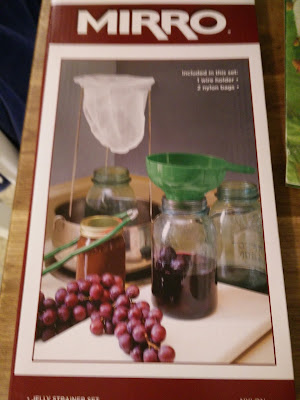
In my last post about grape makgeolli  I mentioned using the Mirro strainer to filter the brew. Many people have been asking for more details about this strainer, so here it is: I bought the strainer on a whim from Amazon while searching for other home-brew and kitchen supplies. At the time it was only about $10, and we also make jams and jellies at home, so the Mirro strainer seemed pretty useful. Luckily, I was right! The strainer took a few minutes to put together; the legs screw into a ring and are secured by 3 small nuts. There are hooks at the bottom of the legs to sit on the rim of a bowl or pot, and the filter bag is mounted inside the ring. The filter bag feels sturdy and there is an elastic band around the top so the bag sits securely on the strainer. Here are a couple action shots: I was very pleased with the bag material and the mesh size, which seemed perfect for straining makgeolli. Keep in mind if you have a very large amount you may need t...

Grape Makgeolli 포도 막걸리

Image
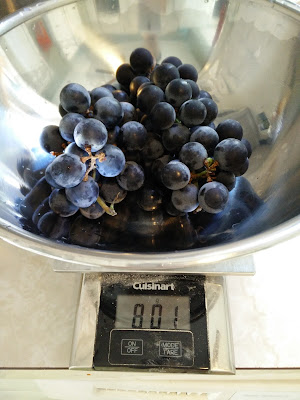
I'm not a grape expert , but I know that Korean grapes are delicious. They have thick, deep purple skins with a characteristic grape aroma. The taste is floral and reminiscent of grape candy, but with all the freshness of real fruit. ~700 grams when stems are removed So when I picked up my latest book on makgeolli brewing a few months back, I knew that I had to try this recipe. This is the first brew in my brewing schedule, which is a list of my planned brews and recipes. Grape Makgeolli 포도 막걸리 This recipe uses a seokim starter that was previously discussed here . The starter establishes a yeast colony ahead of time, so this is technically a two-stage fermentation; however, the seokim is a rather small amount so it does not feel like an iyangju or samyangju. Seokim after ~2 days Ingredients Sweet rice - 1 kg Nuruk - 100 g Grapes - ~700 g Seokim - 250 ml Water - 1.5 l I bought the grapes from my local H-Mart and washed them in vinegar and water. They...