Posts

Showing posts with the label 동동주

Using a Yongsu (용수) for the First Time
Image
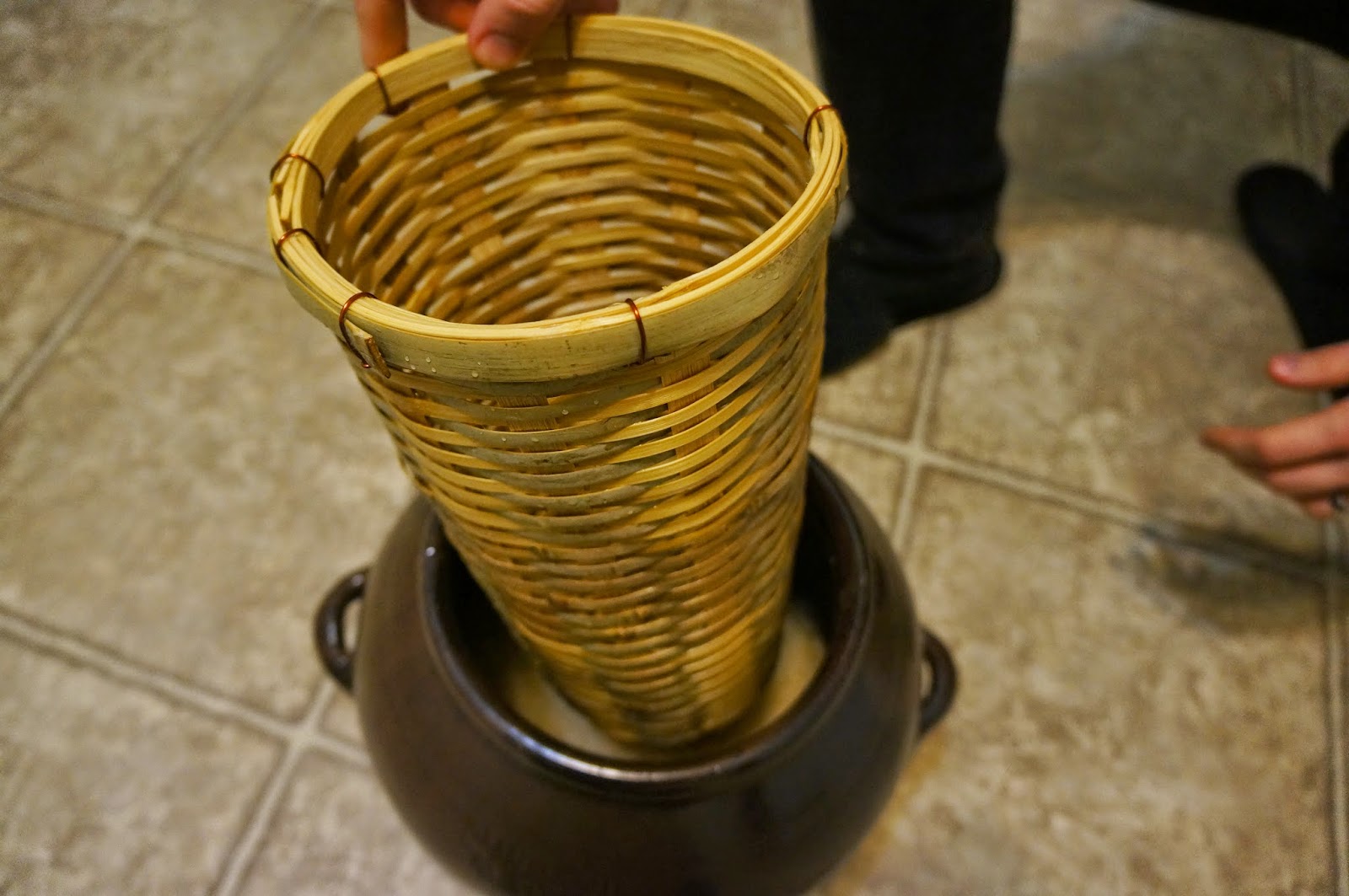
Last time I hinted at brewing for my daughter's first birthday party. That was the intention, but due to the cold weather or slow acting yeast the makgeolli wasn't ready for another week! To make it interesting I decided to try using the Yongsu (용수) for the first time. A yongsu is a woven basket shaped like a cone, with a rounded end instead of a point. The yongsu is placed directly inside a hangari to separate the rice and nuruk from the completed makgeolli or dong-dong ju.  The benefit of the yongsu is that you can scoop out the makgeolli for serving without having to pour out the entire hangari. This eliminates the need to filter in advance, which can be very convenient if you have a large jug of makgeolli. The downside of the yongsu is that any sweetening or flavor must be done separately, which introduces another step. Also, it is quite difficult to clean. To summarize, the yongsu offers the ability to serve makgeolli quickly and unaltered without much e...
First brew in the new house [update]

Image
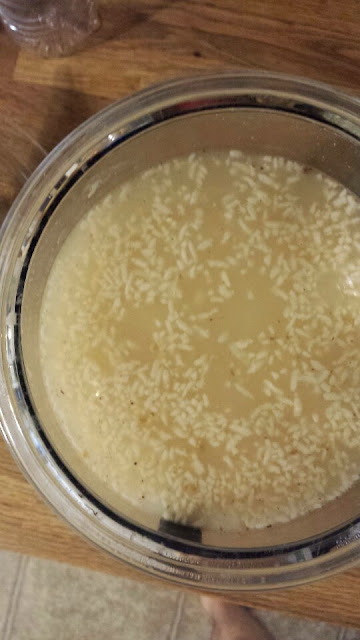
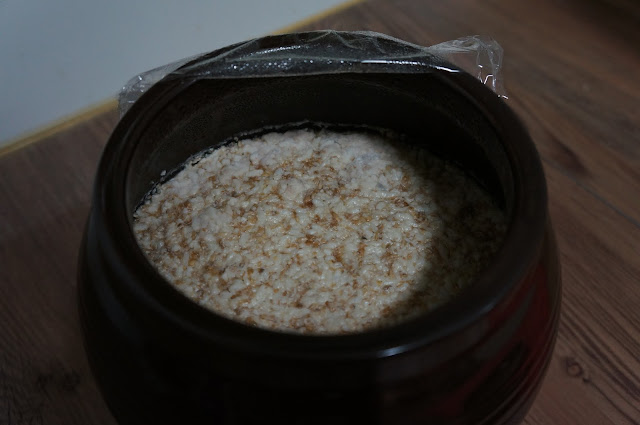
As planned, the nuruk was left to do its thing for 24 hours, and the yeast was pitched in the 24-48 hour window. I proofed the champagne yeast according to the instructions on the package (stir into warm water and let sit for ~15 minutes) and mixed it into the fermenter. There was already some activity going on and the nuruk-rice mixture gave off a familiar scent. I speculate that the smell is indeed the amylase enzymes breaking down the rice and not the scent of yeast, which is somewhat different. The fermenter was stirred once a day for 5 days, and on the 5th day the makgeolli tasted ripe for bottling. There was a slight hint of the sourness that develops when you brew makgeolli without added yeast. I attribute this to the 24 hour wait period before pitching the yeast.  There wasn't time to bottle immediately, so I put the fermenter in the fridge to slow down the fermentation. This is how the makgeolli looked before it went into the fridge. Looks like (동동주) dong-dong j...

부의주 막걸리 (동동주) | Buuiju Makgeolli Pt. 3

Image
Part 1 | Part 2 For the last part I have pictures of the 48 hour mark, 60 hour mark and bottling. I decided to bottle early because we would be out of the apartment and the heat might have ruined the makgeolli if left unattended. At the 48 hour mark there were larger bubbles on the surface of the mixture. @ 48 hours  After stirring, more bubbles formed and there was an audible fizz. @ 60 hours. Pieces of rice and nuruk were starting to sink, and a thin layer of clear makgeolli began to form at the top. Ideally, I would have waited until most of the rice had sunk before bottling, but with this weather... ...I decided to bottle early. I used a steamer cloth to filter the makgeolli. First, some mixture was ladled into the cloth, which was cut in the shape of a bag. Then, the cloth was twisted and squeezed to separate the liquid from the nuruk and rice solids. I repeated this several times with several ladle-fulls at a time in the bag. If there is too m...

부의주 막걸리 (동동주) | Buuiju Makgeolli Pt. 2

Image
Click here to view 부의주 막걸리 (동동주) | Buuiju Makgeolli Pt. 1 For part 2 I'll try to show some stages of the fermentation in 12 hour increments. This picture was taken 12 hours after putting the makgeolli in the onggi. @ 12 hours. @ 24 hours. I took this picture after stirring the mixture. You can see tiny bubbles on top starting to form. @ 36 hours. The plastic wrap has condensation from the fermentation process. Gas is starting to escape from the mixture, and it bubbles up through the surface every few seconds. @ 36 hours. You can see the plastic wrap is pretty moist from condensation. Before removing the plastic wrap for the picture, the surface was raised from the gas trapped underneath. It's not sealed tightly, so gas can escape, but the surface of the plastic wrap is still a little raised. After I stirred this time the bubbles became bigger and were much more visible. I tasted the stirrer and it was pretty sweet. I'll try a spoonful at the 48 ho...

부의주 막걸리 (동동주) | Buuiju Makgeolli Pt. 1

Image
Here is a step-by-step guide for making Buuiju Makgeolli (동동주) Buuiju makgeolli is commonly known as dong-dong ju. "Dong-dong" is onomatopoeia in Korean for floating. This type of makgeolli is often characterized by the floating bits of rice that are left in the finished drink.  Ingredients : 찹쌀 sticky rice 물 water 누룩 nuruk Starting makgeolli is a multi-step process. There isn't room for a "set it and forget it" mentality, so if that is how you usually cook make sure to keep track of the time throughout the process. A summary of the steps is as follows: First, prepare the sugok and rice as they need to soak and/or cool to room temperature. Second, cook and cool the rice. Third, mix sugok, rice, and water together. Last, place the mixture in a fermentation vessel. I will go over each step in more detail below.  First, measure the ingredients to fit your fermentation vessel. Traditionally, a brown clay pot is used, but you can also use glass o...