Posts

부의주 막걸리 (동동주) | Buuiju Makgeolli Pt. 3
Image
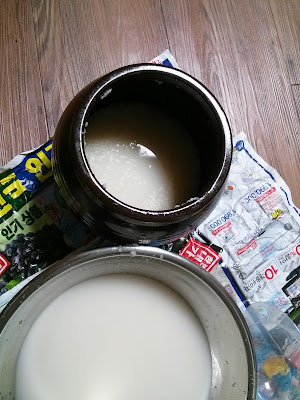
Part 1 | Part 2 For the last part I have pictures of the 48 hour mark, 60 hour mark and bottling. I decided to bottle early because we would be out of the apartment and the heat might have ruined the makgeolli if left unattended. At the 48 hour mark there were larger bubbles on the surface of the mixture. @ 48 hours  After stirring, more bubbles formed and there was an audible fizz. @ 60 hours. Pieces of rice and nuruk were starting to sink, and a thin layer of clear makgeolli began to form at the top. Ideally, I would have waited until most of the rice had sunk before bottling, but with this weather... ...I decided to bottle early. I used a steamer cloth to filter the makgeolli. First, some mixture was ladled into the cloth, which was cut in the shape of a bag. Then, the cloth was twisted and squeezed to separate the liquid from the nuruk and rice solids. I repeated this several times with several ladle-fulls at a time in the bag. If there is too m...

부의주 막걸리 (동동주) | Buuiju Makgeolli Pt. 2

Image
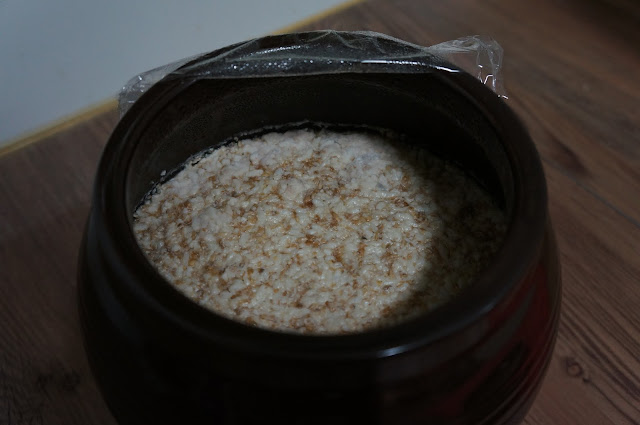
Click here to view 부의주 막걸리 (동동주) | Buuiju Makgeolli Pt. 1 For part 2 I'll try to show some stages of the fermentation in 12 hour increments. This picture was taken 12 hours after putting the makgeolli in the onggi. @ 12 hours. @ 24 hours. I took this picture after stirring the mixture. You can see tiny bubbles on top starting to form. @ 36 hours. The plastic wrap has condensation from the fermentation process. Gas is starting to escape from the mixture, and it bubbles up through the surface every few seconds. @ 36 hours. You can see the plastic wrap is pretty moist from condensation. Before removing the plastic wrap for the picture, the surface was raised from the gas trapped underneath. It's not sealed tightly, so gas can escape, but the surface of the plastic wrap is still a little raised. After I stirred this time the bubbles became bigger and were much more visible. I tasted the stirrer and it was pretty sweet. I'll try a spoonful at the 48 ho...

부의주 막걸리 (동동주) | Buuiju Makgeolli Pt. 1

Image
Here is a step-by-step guide for making Buuiju Makgeolli (동동주) Buuiju makgeolli is commonly known as dong-dong ju. "Dong-dong" is onomatopoeia in Korean for floating. This type of makgeolli is often characterized by the floating bits of rice that are left in the finished drink.  Ingredients : 찹쌀 sticky rice 물 water 누룩 nuruk Starting makgeolli is a multi-step process. There isn't room for a "set it and forget it" mentality, so if that is how you usually cook make sure to keep track of the time throughout the process. A summary of the steps is as follows: First, prepare the sugok and rice as they need to soak and/or cool to room temperature. Second, cook and cool the rice. Third, mix sugok, rice, and water together. Last, place the mixture in a fermentation vessel. I will go over each step in more detail below.  First, measure the ingredients to fit your fermentation vessel. Traditionally, a brown clay pot is used, but you can also use glass o...

Introduction.

I've made previous posts in the past about makgeolli on my personal blog here . However most of the traffic on that blog has been due to my posts about makgeolli alone. Thus, this will be a blog devoted solely to makgeolli brewing and related discussions.  If you have an interest in makgeolli, please enjoy.  Although my knowledge is relatively beginner, I am happy to share what little I do know about makgeolli with those who are curious.  Cheers.

Spring Makgeolli Making

I've made two batches this spring. One triple-feed, and one single-feed makgeolli. For the triple-feed I followed the recipe for Samyangju. Since it was the spring, temperatures were increasing and I didn't need to rely on my electric heating pad to keep the makgeolli at 25 C while it fermented. Hooray! On the flip side, warmer temperatures can mean a higher chance to develop unwanted mold growth on the surface of the makgeolli. Boo! If you are brewing in a warmer climate, make sure to clean your tools well. Also, the warmer temperatures increase metabolic rate of the microorganisms present in the makgeolli. As such, a batch that may originally take 5-7 days in colder temperatures may only take 3-5 days. When I tasted the fresh samyangju, I didn't like it very much. There were some extra pieces of sediment that passes through the filter and left a grainy feeling. I bottled the remainder and placed it in the refrigerator. A month later someone requested to try the...

Single-Feed Makgeolli Recipe

Makgeolli has several types/classifications. The easiest way to explain it (IMO) is to classify them by the number of feeds. I previously wrote about  Samyangju  삼양주, which has three feeds, but there are also two-feed and single-feed varieties. This is a  basic recipe  taken from the makgeolli book I purchased a while back. Please visit the  previous makgeolli post  for a list of  tools  for making makgeolli. The Recipe: This recipe is for a small batch (1-2 liter yield) single-feed makgeolli. The recipe has 3 ingredients, each requiring some preparation, but it is a much shorter process than samyangju since it is single-feed. I consider this a simple recipe, but it is not the simplest. For example, there are recipes where the process can be further shortened by adding yeast. The addition of yeast decreases brewing time and forgoes the need to specially prepare the nuruk. On the other hand, this recipe is very simple in terms of ingr...

Making Makgeolli, the Korean Edition

Image
Making Makgeolli, the Korean Edition! 한국에서 막걸리 만들자~ I continued my interests in making makgeolli while working here in Korea. I couldn't possibly have a better opportunity to understand the beverage and learn the many variations and nuances on how it is made. Thankfully there have been several books published on the topic of makgeolli home brew. Fortunately, I have a loving fiance who is patient and willing to translate and help me understand the books, which are written in Korean. Maybe when my Korean skill gets better I'll work at an English translation of the book(s). I started by visiting the book store and picking up a book which seemed to have a clear process and interpretation of each recipe. The book classified the different types of makgeolli and discussed their characteristics quite extensively. I will get into an explanation of types later, and for now I will stick to a  basic recipe . The book also listed the most common and most useful  tools  for mak...