Posts

Brew preview

Image
Coming soon... Makgeolli for the bunnies

Blueberry Makgeolli @해달밥술

Image
On a recent trip to Korea I stopped for dinner at a restaurant serving slow food and Makgeolli: 해달밥술 (Haedalbapsool). My friend had wanted to take me to a place that serves Makgeolli since she found out about my hobby and this blog. We walked around Yeon nam dong (연암동) in Seoul for a while looking for somewhere that serves Makgeolli. The first place we went to was only serving soju; they have Makgeolli on a seasonal menu, but not this season!  We searched and walked some more to the second place, which was temporarily closed. We thought it was a bummer because they supposedly had house made Makgeolli. On we walked, following my suggestion to go to a place near Hongdae station where I remembered seeing a Makgeolli restaurant two years back. We didn't find the place I had remembered; instead we stumbled upon 해달밥술. From the exterior it looks like a humble 식당 with simple tables and stools and a...

Instant Makgeolli? Hwajoodang Makgeolli Pack

Image
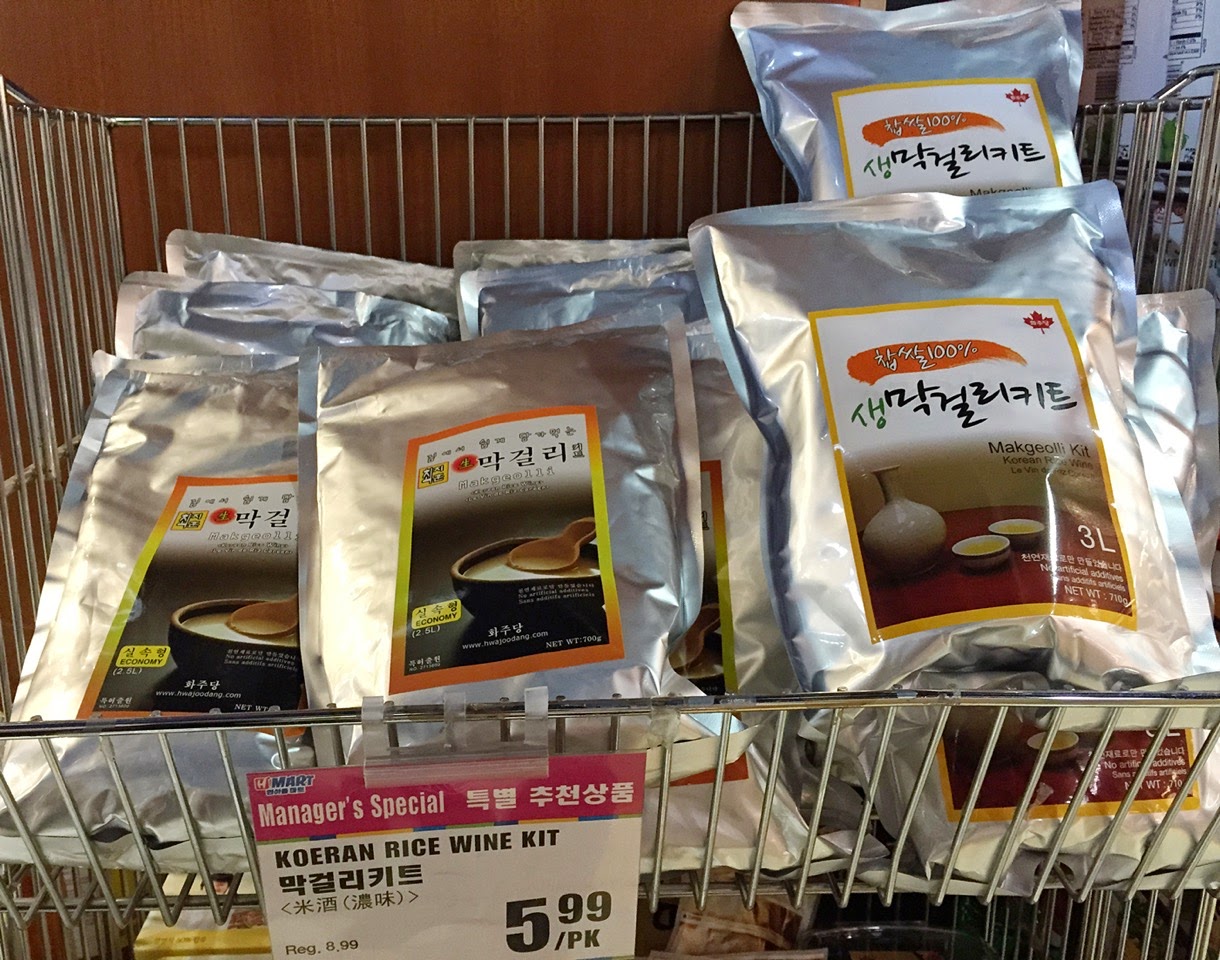
Claire from YVR has brought to my attention an interesting product from across the northern border. Hwajoodang's Makgeolli Pack ! Claire had posted previously about her makgeolli experience on her blog here . Judging from her post, she had the opportunity to try some unique, high-quality makgeolli. At the end of her post she resolves to make her own batch of home brewed makgeolli, which led her to the package pictured above, and below.  I won't steal her thunder by posting pictures of her brew in the works. Please check out her blog and watch for her makgeolli post in the near future.  On to the pack... The makgeolli pack is a prepackaged kit of all the ingredients needed to make makgeolli. The website doesn't have too much info on the product, such as ingredients or how much of each ingredient is in the pouch, but they do publish a how-to here . Thanks to Claire's contribution, we also have the above picture of the directions from the back of the pac...

Using a Yongsu (용수) for the First Time

Image
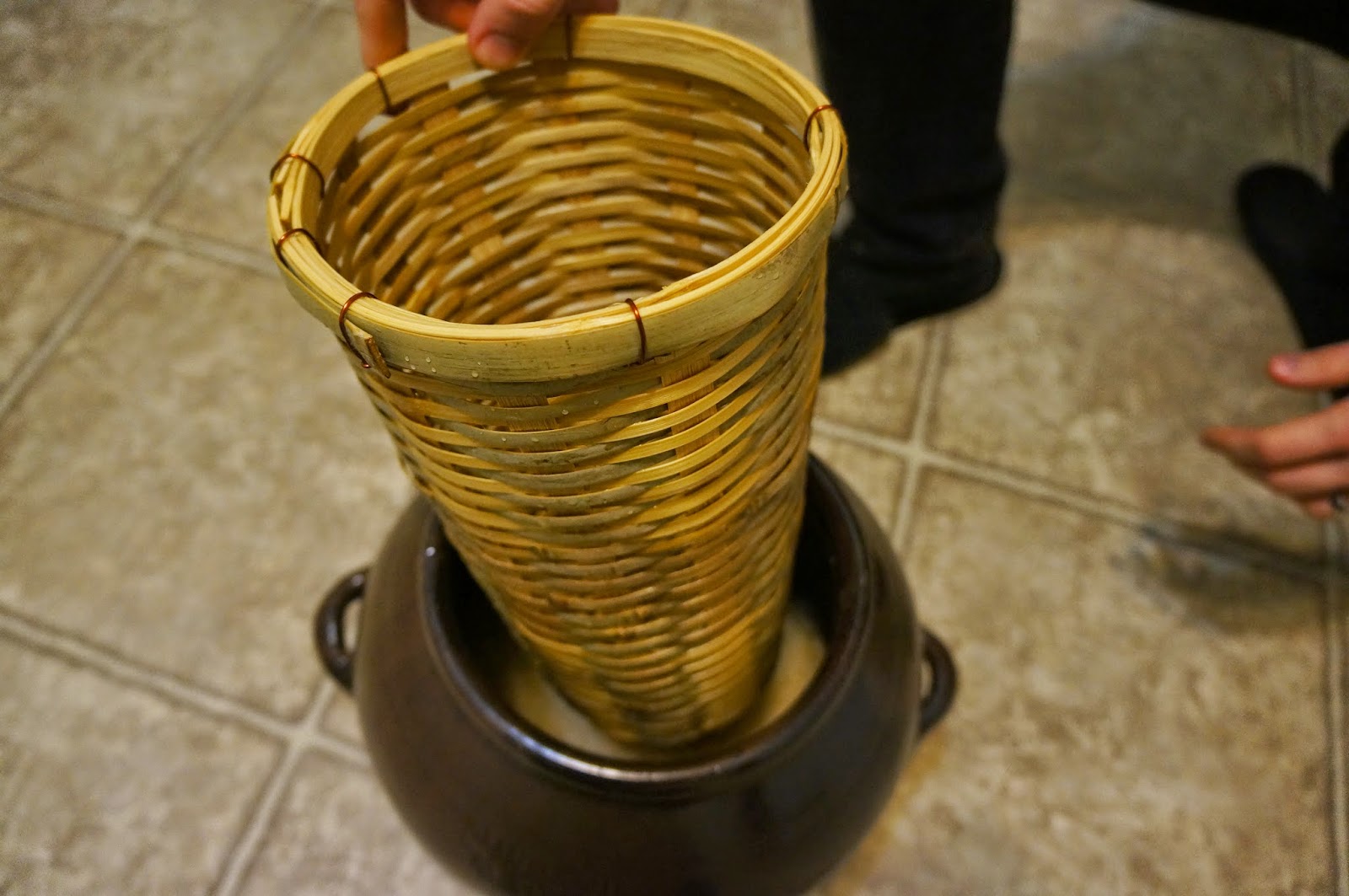
Last time I hinted at brewing for my daughter's first birthday party. That was the intention, but due to the cold weather or slow acting yeast the makgeolli wasn't ready for another week! To make it interesting I decided to try using the Yongsu (용수) for the first time. A yongsu is a woven basket shaped like a cone, with a rounded end instead of a point. The yongsu is placed directly inside a hangari to separate the rice and nuruk from the completed makgeolli or dong-dong ju.  The benefit of the yongsu is that you can scoop out the makgeolli for serving without having to pour out the entire hangari. This eliminates the need to filter in advance, which can be very convenient if you have a large jug of makgeolli. The downside of the yongsu is that any sweetening or flavor must be done separately, which introduces another step. Also, it is quite difficult to clean. To summarize, the yongsu offers the ability to serve makgeolli quickly and unaltered without much e...

50/50 White Rice/Brown Rice Makgeolli

Image
Hey, it's been a while. I've been busy with grad school courses, and we've been busy at home with holidays and preparing for my daughter's first birthday party. We are doing a few traditional Korean things, such as Dol-jabi, and having some Korean finger-foods on hand to celebrate. Naturally, I'll be making some makgeolli to go along with the food. There will be more on that in the coming weeks, but for now... Persimmon for additional autumn effect, not actually used in this makgeolli 50/50 Makgeolli  (50% White Rice/50% Brown Rice) This is a small, experimental brew in using 250 grams of white glutenous rice and 250 g of brown glutenous rice. Once diluted, it should yield about 2 liters of makgeolli, with some left over for...cooking? Preparation : Clean and/or sterilize all equipment used for cooking rice and brewing makgeolli. This is a basic good practice for all food applications, especially when you are serving other people. Another bonu...
A brew for the in-laws

Image
 My in-laws were visiting from Korea this month, and I decided to make some fresh makgeolli for them to enjoy. I also wanted to test my makgeolli on the taste buds of Koreans who are more familiar with the run-of-the mill makgeolli. Unfortunately, I was away on business most of the week, so I only have a few pictures this time. My lovely helper was at home keeping an eye on the brew while I was gone. This brew was made with the same ratio as my last post, but with different yeast. The plan was to pick up wine yeast after work, but the brew store is closed on Mondays, a fact that I didn't learn until I walked up to their door. I was in a hurry to brew and pack my things for the business trip, so I had to settle for baker's yeast, which was the only thing available at home. I also used a different nuruk this time. I used about all of the Choripdongi 초립동이 nuruk, so it was time to open the Haeoreum 해오름 and try it out. The first thing I noticed was the ...

First brew in the new hangari

Image
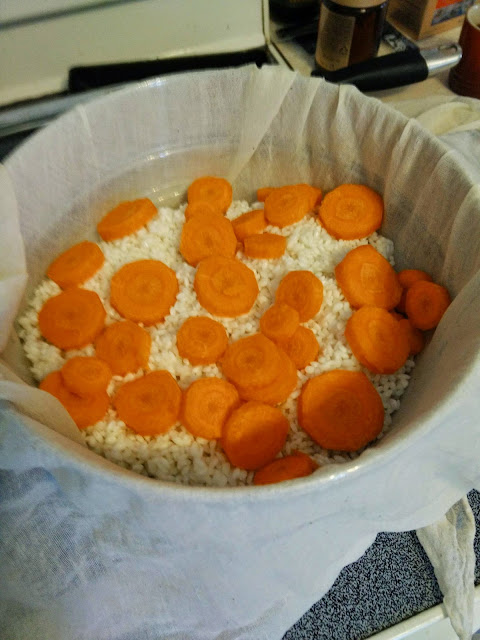
On Sunday I started a fresh brew in the new hangari. What's a hangari? You can find out the basics in my last post here . Ingredients I am continuing to use the following ratio, which was taken from the book Making, Drinking, and Enjoying Makgeolli.  If you are interested in the brand of rice, type of water, nuruk, etc. please leave a comment below and I'll be happy to provide more details. For sweetening, honey and brown rice syrup are used. Process The brew started by preparing the rice. The rice was washed by running water over the rice while swooshing it around in a metal colander. A pot was placed under the rice to  periodically check the color of the water running through the rice. When the water was mostly clear the rice was moved to a clean pot, which was filled with enough water to cover the rice. The uncooked rice soaked overnight. In the morning the rice was drained and steamed in a deep pot with a steamer basket. I have a cheesecloth that I use for...