Posts

Dual Brew: Added Yeast | 100% Nuruk
Image
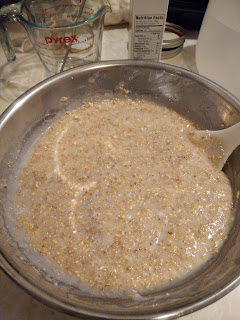
I haven't posted in a while, but a lot of good things have been happening. I've been doing a lot of travel for work, and talking to some wonderful people from the makgeolli brewing community in Korea. As part of those discussions the following two brews came about: An Iyangju using added yeast, and a Danyangju using nuruk only. Both brews used 100% sweet rice and a sweet rice starter. I'll explain each one below. The starter. The starter used is a bit of a trade secret (shhh), but I will tell you this. It uses rice flour, nuruk and water. That's it. Freshly made starter  Had I developed this starter on my own I'd share more specific details with you, but this was shared with me by a friend requesting confidentiality. The starter was made and let sit for 24-48 hours, depending on the progress. I added yeast to one starter and it took off and was about a day ahead of the nuruk only starter, which took about 72 hours. This was expected and be...
Mirro Strainer

Image
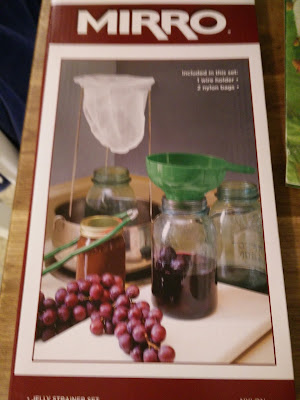
In my last post about grape makgeolli  I mentioned using the Mirro strainer to filter the brew. Many people have been asking for more details about this strainer, so here it is: I bought the strainer on a whim from Amazon while searching for other home-brew and kitchen supplies. At the time it was only about $10, and we also make jams and jellies at home, so the Mirro strainer seemed pretty useful. Luckily, I was right! The strainer took a few minutes to put together; the legs screw into a ring and are secured by 3 small nuts. There are hooks at the bottom of the legs to sit on the rim of a bowl or pot, and the filter bag is mounted inside the ring. The filter bag feels sturdy and there is an elastic band around the top so the bag sits securely on the strainer. Here are a couple action shots: I was very pleased with the bag material and the mesh size, which seemed perfect for straining makgeolli. Keep in mind if you have a very large amount you may need t...

Grape Makgeolli 포도 막걸리

Image
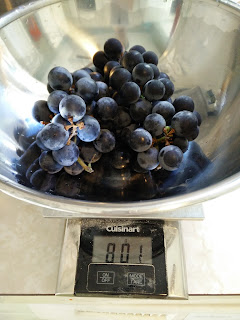
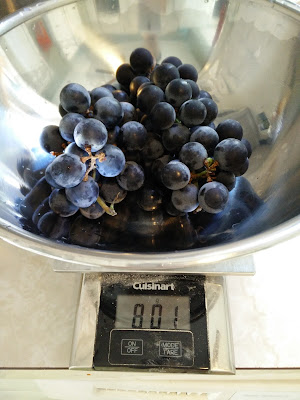
I'm not a grape expert , but I know that Korean grapes are delicious. They have thick, deep purple skins with a characteristic grape aroma. The taste is floral and reminiscent of grape candy, but with all the freshness of real fruit. ~700 grams when stems are removed So when I picked up my latest book on makgeolli brewing a few months back, I knew that I had to try this recipe. This is the first brew in my brewing schedule, which is a list of my planned brews and recipes. Grape Makgeolli 포도 막걸리 This recipe uses a seokim starter that was previously discussed here . The starter establishes a yeast colony ahead of time, so this is technically a two-stage fermentation; however, the seokim is a rather small amount so it does not feel like an iyangju or samyangju. Seokim after ~2 days Ingredients Sweet rice - 1 kg Nuruk - 100 g Grapes - ~700 g Seokim - 250 ml Water - 1.5 l I bought the grapes from my local H-Mart and washed them in vinegar and water. They...

Brewing Schedule

I've decided to introduce a new feature to plan future brews. A brewing schedule will be displayed on the side navigation  with a list of upcoming brews or brewing projects. There are no hard dates or deadlines for each brew as I still have a full-time job and family to take care of. The list is intended to be an FYI of what has been completed and what is in the works. So check out the schedule and leave a comment if there is anything that you are particularly interested in. Cheers!

Brew Preview (포도 막걸리)

Image
Coming soon... I heard it through the grapevine.

Green Tea Makgeolli 녹차 막걸리

Image
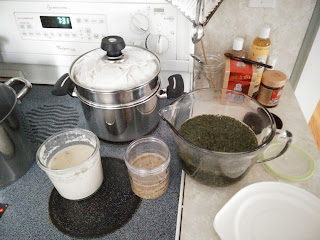
I'm starting my journey into infusing different ingredients during the brewing process. This move in inspired by a new book I picked up 술 만들기, and a recent delivery of ingredients from the in-laws. I'll post more info on those ingredients soon, but for today... Green Tea Makgeolli  녹차 막걸리 For this brew I used a starter instead of pitching yeast in with the rice and nuruk. The starter is called seokim (석임) and was introduced in a previous post here . I'll explain how to make seokim below using the ratio from the previous post.  The green tea used was a gift from my aunt, a delicious Jeju green tea blend. I've been enjoying the tea itself for some time now and thought it would be a good compliment to this recipe.  Here's what you'll need: For the seokim 석임 starter 250g rice flour 50g nuruk 2.5g wine yeast 25g wheat flour  300~400ml water (boiled) In a large bowl, mix the rice flour with the boiling water. Add a little bit of water a...

Makgeolli Starter (석임) Testing

Image
석임 For the upcoming brew I decided to do something a little different. Usually I steam the rice, making godubap 고두밥, and to that I add nuruk 누룩, yeast, and water. This is normal for me and it's what I've been doing for years (except for that year in Korea when I didn't use yeast). This time I will use what is called seokim 석임 . What's seokim? Seokim is a starter that can be used to brew makgeolli. It's started a few days ahead of the actual brew, and is added to the primary fermentation ingredients in place of yeast. What's seokim made of? It's actually pretty simple. Seokim uses all of the same ingredients as a makgeolli brew, just in a smaller size and different ratio. For example, the seokim recipe I used calls for 250g rice flour, 50g nuruk, 2-3g wine yeast, 25g whole wheat flour, and about 500ml water. Freshly made seokim Using seokim the brew hits the ground running, powered by yeast that are primed and ready to go....